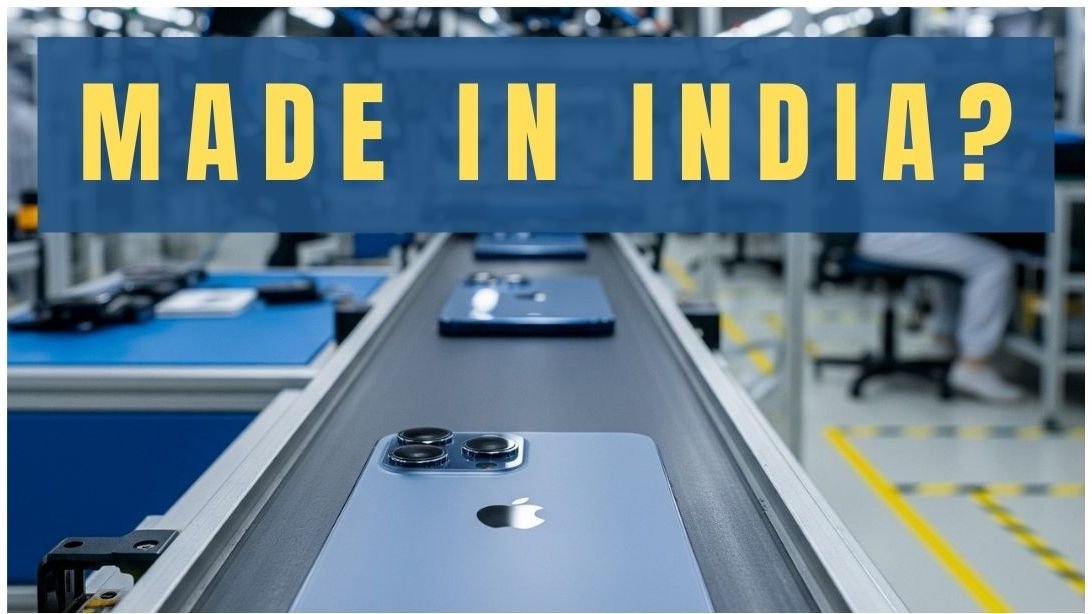
is iPhone really “Made in India”?
Your favorite iPhone may not actually be made in India—think again. When you see “Made in India,” it might just mean the product was assembled here, not fully manufactured. Many buyers on Reddit voice that awareness gap: “I thought buying ‘Made in India’ supported local industry—but most parts are imported.”
The distinction is critical. A “Made in India” label carries different meanings depending on the industry.
For textiles, the process—from growing cotton to weaving fabric—often stays entirely Indian.
For electronics, however, chips might be designed here but manufactured in Taiwan or the U.S., with parts imported from China. Assembly then happens in Indian factories.
True “Made in India” only applies when every part is produced here—not just the final assembly. That difference matters for conscious buyers who want to know where their money is going and which industries they’re actually supporting.
1. Made in India – Government Initiatives
The Indian government has invested heavily in turning assembly into end-to-end production. The PLI (Production Linked Incentive) schemes have already attracted ₹1.76 lakh crore in investments, generated ₹16.5 lakh crore worth of production, and created over 12 lakh direct and indirect jobs across 14 sectors as of March 2025.
The schemes cover electronics, textiles, pharmaceuticals, and more.
For instance, in textiles—India’s oldest industry—the process is largely domestic. Cotton is grown, dyed, and woven locally.
These are products you can confidently call “Made in India.”
On LinkedIn, a manufacturing leader summed it up: “PLI has enabled us to localize 60% of components formerly imported.” For buyers, that translates into stronger domestic supply chains, better quality control, and products that are less dependent on volatile global imports.
The government’s vision is to push industries from just assembling to building core components, and incentives like PLI are the first steps toward that transformation.
2. Make in India – Buyer Perspective
Launched in 2014, the Make in India campaign is designed to showcase India as a global manufacturing hub. While the initiative has attracted foreign direct investment (FDI) and boosted exports, the buyer’s perspective reveals a more layered picture.
Components like integrated chips are often only designed in India—by companies like Intel and AMD—but manufactured overseas. Reddit commentary mirrors this nuance: “Assembly here helps lower costs, but the design and production of core parts remain outside India.”
Still, the benefits are visible. Indian electronics exports are steadily growing. Between FY2020 and FY2024, electronics exports nearly doubled, reflecting global interest in India as a manufacturing partner.
For buyers, the takeaway is two-fold:
- You’re supporting Indian jobs and industries even if the parts come from abroad.
- You’re contributing to the scaling of domestic capabilities, which may eventually reduce reliance on imports.
As one Redditor put it: “It’s not perfect, but every phone or appliance we buy that’s made here helps move the needle toward true self-reliance.”
3. Assembled in India – Global Parts, Indian Build
Electronics giants like Foxconn and Dixon Technologies have set up large-scale assembly lines in India. While this boosts employment and reduces shipping costs, the reality is that critical components are still imported.
Most smartphones assembled in India rely on chips from Taiwan or the U.S. and circuit boards or batteries from China. A LinkedIn supply chain professional put it plainly: “Assembly in India allows region-specific tweaks, but chipmaking remains external.”
This phenomenon isn’t limited to consumer electronics. Even India’s most celebrated scientific feats, like ISRO’s rockets, depend on imported high-tech parts. Around 95% of rocket components are domestically manufactured, but about 5%—especially precision electronics—still come from abroad.
For buyers, this means:
- Price benefits: locally assembled products avoid high import tariffs.
- Faster support and servicing: parts are stocked in India.
- But not fully Indian-made: assembly ≠ manufacturing.
That distinction matters if you’re consciously supporting homegrown innovation versus just reducing import bills.
4. Future of Make in India – Component Manufacturing & Chip Integration
The government is shifting gears from just assembly to component-level manufacturing. In early 2025, a new ₹22,900 crore Component Manufacturing Scheme was launched, replacing older PLIs to focus on sub-assemblies and capital equipment in electronics.
In parallel, a $2.7B PLI scheme aims to bring in $7B of investment and 91,000 new jobs over five years. The focus is on semiconductors, chip integration, and modules—the heart of future electronics.
Industry voices on LinkedIn are optimistic: “Finally, chip integration and modules may be built here—not just assembled.”
For buyers, this future means:
- Genuinely Indian-made tech products with higher domestic value-add.
- Lower long-term costs, as dependence on foreign suppliers reduces.
- Stronger after-sales service, because spares and upgrades are available locally.
Think of it this way: today’s iPhone may only be assembled in India. Tomorrow’s “Made in India” smartphone could feature Indian-made chips, batteries, and modules—making the label truly authentic.
5. Made in India – Pricing & Value
Price remains the most visible difference for buyers. Local assembly already reduces import tariffs and logistics costs, making phones and electronics up to 10–20% cheaper compared to fully imported units.
A Reddit user summed it up: “Phones assembled here cost less than imports and have better support locally.”
But the value goes beyond immediate savings. Locally produced textiles and electronics are easier to service, repair, and upgrade. Buyers don’t just save money upfront—they benefit from longer product lifespans and accessible after-sales networks.
As production scales, these savings are expected to grow. Government incentives encourage manufacturers to source more components domestically, which reduces currency fluctuations and import dependency. For the buyer, that means stable pricing and predictable value in the long term.
Conclusion
So, what does “Made in India” really mean? At present, it’s often a hybrid story: global parts, assembled on Indian soil, supported by Indian jobs. But initiatives like PLI and the new Component Manufacturing Scheme are steadily changing that equation.
Truly “Made in India” means every component—from cotton in textiles to chips in electronics to modules in rockets—is manufactured domestically. We’re not fully there yet, but we’re moving closer with every policy and every factory expansion.
As a buyer, the next time you see the “Made in India” label, pause to ask:
- Is this product like our textiles—fully Indian?
- Or is it like the iPhone—assembled here with global roots?
Because when every part is manufactured in India, that’s when it’s truly Made in India. And as buyers, recognizing the difference helps us make informed, value-oriented purchases that shape the industries of tomorrow.
Sources
Government of India, Ministry of Commerce & Industry – PLI Scheme Reports
Press Information Bureau, March 2025 Investment Data
LinkedIn posts from Indian manufacturing leaders (2024–2025)
Industry Whitepapers – Automotive & Textile Localization Studies
ET Auto / Economic Times Manufacturing Coverage
Disclaimer:
The information in this article is compiled from publicly available reports, government releases, and industry sources. While every effort has been made to ensure accuracy, manufacturing processes and policies may change over time. Readers are encouraged to verify details independently before making business or purchase decisions.